

For all essential spirometry testing
The modular JAEGER Vyntus™ PNEUMO belongs to the Vyntus Family and is combinable with Vyntus APS for bronchial challenge testing and/or Vyntus IOS Impulse Oscillometry for measuring central and peripheral airway resistance.
Use your Vyntus Pneumo for all of the essential spirometry testing: Flow/Volume-loop (FVC), Slow Vital Capacity (SVC), Maximum Voluntary Ventilation (MVV), Pre and Post medication testing or therapy control.
Optionally, Vyntus Pneumo allows expanding your diagnostic possibilities with measurements like Rocc, P0.1, Pmax, SNIP, rhinomanometry and compliance. Vyntus Pneumo is enhanced by the workflow- and quality-driven SentrySuite™ Software.
The reliable, proven, accurate, heated Jaeger pneumotach has been selected as the measurement device of choice in hundreds of publications. Its excellent dynamic range allows for testing a broad population, from small children to athletes. Thousands of PFT labs profit daily from its high performance.
The ultimate training tool
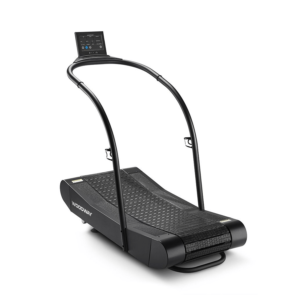
Incorporate a new dimension into your training with the patented WOODWAY Curve. The completely self-powered, manual WOODWAY Curve Treadmill offers a one-of-a-kind workout experience that requires zero electricity.
Feel the freedom of this totally manual treadmill while running or walking on the unique curved running surface where you are the motor. The Curve Treadmill challenges the entire body while burning up to 30% more calories than any other treadmill.
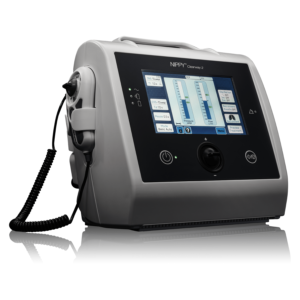
Versatile Airway Clearance
Introducing the Clearway 2 with TreatRepeat®. The second-generation MI-E device by Breas incorporates the latest technology to bring effective and accurate treatment for patients requiring airway clearance and cough assistance. TreatRepeat function allows clinicians to manually deliver different numbers of insufflations and exsufflations and then save the treatment they have just delivered to the device to be repeated automatically. Helping to improve accuracy and speed of titration and set-up.
Multiple mode options
Up to four treatment profiles can be saved to the device.The settings used in the manual and programmed modes are also saved to the device. This allows for up to 7 MI-E prescriptions to be saved. The treatment settings in the IPPB and NIV modes are also saved. The programmable mode enables the delivery of multiple insufflations as part of a cough cycle.
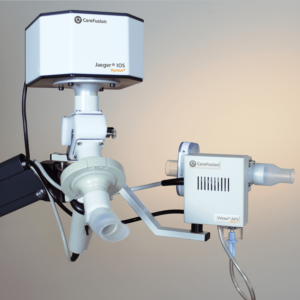
IOS Impulse Oscillometry
Tidal breathing analysis with Impulse Oscillometry (IOS) has demonstrated to be informative and differentiated in the early detection and follow up of pulmonary diseases like asthma, COPD and idiopathic pulmonary fibrosis. IOS is almost independent of patient cooperation and can test a larger patient range than spirometry alone, from children to adult to geriatric patients.
IOS is available as a stand-alone device combined with a spirometry measurement program (MasterScreen IOS and Vyntus IOS) or as an add-on module to the MasterScreen series.