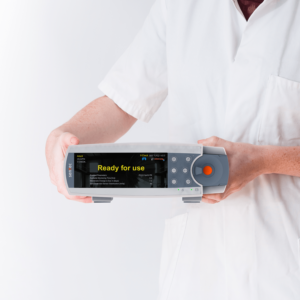
Sentec Digital Monitor (SDM) with activated PO2 channel for tcPCO2, tcPO2, SpO2, PR and HP monitoring
The Sentec Digital Monitoring System with PO2 (SDMS-PO2) provides continuous and non-invasive real-time monitoring of ventilation (tcPCO2), oxygenation (tcPO2) and Heating Power (HP) for neonatal patients. In pediatric / adult patients, the system can be used for tcPCO2, tcPO2, SpOI2, Pulse Rate, Pulsation Index (PI) and HP monitoring.
Transcutaneous monitoring (TCM) provides clinicians with greater insight to quickly identify trends, rapidly and accurately assess patient status, and make more well-informed, timely care decisions.
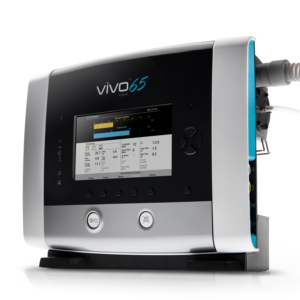
Meeting the needs of both medical staff and patient
The Vivo 65 is designed to meet the needs both of medical staff and a wide range of patients. It combines comfortable and controllable ventilation with excellent monitoring capabilities to potentially reduce readmissions to acute care facilities.
The Vivo 65 is an advanced homecare ventilator designed to deliver secure and comfortable (life-support) treatment to adult and pediatric patients from 5 kg. The Vivo 65 can be used for a wide variety of patients thanks to a comprehensive set of modes, circuits and accessories.
The dual limb circuit allows for measurement of exhaled volumes providing additional security. The extensive moni- toring capabilities help obtain a better insight into the quality of ventilation. The Vivo 65 is an excellent choice for mechanical ventilation at home, in the hospital and in long- term care facilities. The Vivo 65 is prepared for connection to Breas cloud solutions.
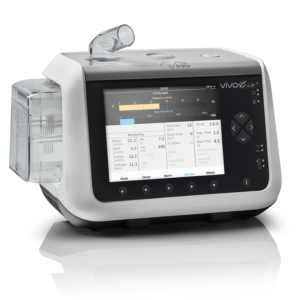
Designed For EveryDay Life– Now with Auto-EPAP
To meet the needs connected to a wide range of respiratory conditions a ventilator must offer outstanding clinical versatility and performance. But equally important, it must be designed around the patient’s life, activities and home environment. Vivo 45 LS is a life support ventilator for adult and pediatric patients from 5 kg. The Vivo 45 LS is designed to maximize independence and mobility.
Designed for everyday life

The dual-valved LiteAire MDI holding chamber: Collapsible, disposable paperboard design.
The LiteAire® collapsible MDI holding chamber is a unique MDI holding chamber and an innovative alternative. LiteAire’s unique dual-valved MDI holding chamber design delivers pop-up convenience and effective drug output at a fraction of the cost of most plastic holding chambers. In many clinical settings, the LiteAire can reduce costs by replacing existing rigid plastic holding chambers or inefficient spacers with a paperboard alternative. The unique design allows the LiteAire to be reused by a patient over multiple doses and meets and often exceeds the performance of plastic holding chambers.
 Birdy Brochure